How to Plan a Home Renovation in Longview, TX: The Complete Step-by-Step Blueprint
From City of Longview permit requirements and reactive red clay soil assessments to contractor scheduling and roll-off dumpster staging, here is your definitive local roadmap to completing your renovation on time and on budget.
- → 1. Scope, Vision & Must-Haves
- → 2. Budget & Contingency Reserves
- → 3. Soil, Climate & Foundation Checks
- → 4. City of Longview Permits
- → 5. Vetting East Texas Contractors
- → 6. Waste Management & Dumpsters
- → 7. Demolition Day & Material Sorting
- → 8. Rough-In, Inspections & Finishes
- → Frequently Asked Questions
Embarking on a residential remodel in East Texas is an exciting milestone. Whether you are updating a 1970s brick ranch in Spring Hill, gutting a mid-century kitchen in Pine Tree, or restoring a character home near Downtown Longview, a successful renovation doesn't happen by accident. It happens through methodical, disciplined planning.
Every year across Gregg and Harrison counties, dozens of homeowners find themselves paralyzed by ballooning material invoices, failed city rough-in inspections, structural foundation cracking, and mountains of construction debris stranded in their front yards. The difference between a remodel that finishes smoothly under budget and one that spirals into a stressful nightmare always comes down to pre-construction due diligence.
In this comprehensive guide, our local dispatch and site operations team breaks down the exact 8-step blueprint you need to plan, permit, finance, and execute a residential home renovation in Longview and surrounding East Texas communities.
Phase 1: Define Project Scope & Prioritize Your Living Space
Before calling an architect or picking out cabinet door profiles, you must establish an uncompromising project scope. Are you pursuing a targeted cosmetic refresh or a full down-to-the-studs gut renovation?
In the East Texas real estate market, certain renovations yield significantly higher returns on investment (ROI) than others:
- Kitchen Overhauls: Reconfiguring kitchen layouts, replacing particleboard cabinets with solid wood shaker cabinetry, and installing quartz or granite countertops regularly recoups 70% to 80% of costs upon resale in Gregg County.
- Primary Bathroom Suites: Upgrading fiberglass tub inserts to curbless tile walk-in showers and double vanities adds immense day-to-day lifestyle comfort and immediate appraisal value. (See our dedicated guide: What Size Dumpster for a Bathroom Remodel?).
- HVAC & Energy Efficiency: In our humid Piney Woods climate, replacing aging ductwork and upgrading to a high-SEER heat pump system prevents indoor moisture issues and slashes high summer electric bills.
Create a two-column master sheet: "Non-Negotiable Essentials" (e.g., repairing structural framing, rewiring outdated fuse panels, fixing subfloor rot) versus "Aesthetic Upgrades" (e.g., designer brass fixtures, custom pantry built-ins, heated bathroom floors). When unforeseen costs arise later in the job, you will immediately know where to trim without compromising your structural integrity.
Phase 2: Build a Realistic East Texas Budget (With a Non-Negotiable Contingency)
Cost overruns rarely happen because homeowners bought high-end faucets. They happen because homeowners failed to budget for the concealed infrastructure hidden behind 40-year-old sheetrock.
Never start demolition until you have 15% to 20% in reserve funds above your contractor's estimated bid. East Texas homes built between 1950 and 1985 frequently harbor galvanized water lines, ungrounded aluminum branch circuits, termite-damaged floor joists, or subfloor sagging that can only be diagnosed once walls and flooring are stripped away.
Below is a standard allocation model recommended by seasoned East Texas residential project managers:
| Budget Category | Recommended % Allocation | What It Covers |
|---|---|---|
| Skilled Trade Labor | 32% – 38% | Licensed electricians, master plumbers, HVAC techs, drywall finishers & framers |
| Core Materials & Lumber | 25% – 30% | 2x4 framing, moisture-resistant drywall, subfloor plywood, insulation, cement backerboard |
| Fixtures & Finishes | 18% – 22% | Cabinets, quartz/granite counters, tile, plumbing trim, vanity units, lighting, paint |
| Contingency Buffer | 15% – 20% | Hidden structural repairs, dry rot, electrical updates, foundation leveling unforeseen fixes |
| Permits & Waste Disposal | 3% – 5% | City of Longview plan review, trade permits, on-site roll-off dumpster rentals & hauls |
Phase 3: Crucial East Texas Site Assessment: Red Clay Soils & Climate
Planning a renovation in Longview requires understanding local geology. Our regional subgrade is dominated by expansive East Texas red clay soils. Unlike sandy or rocky terrain, red clay behaves like an accordion: it expands dramatically when saturated with heavy winter rainfall and shrinks severely during 100°F summer droughts.
This cyclic swelling and shrinkage places continuous upward and downward thrust on residential slab-on-grade foundations and pier-and-beam perimeter footings. Before you spend \$30,000 on custom cabinetry or knock out an interior wall to create an open concept living room, execute these three critical structural assessments:
- Check Foundation Levelness: Use a digital altimeter or water level across your main slab. If there is a variation greater than 1.5 inches across a 25-foot span, foundation underpinning or helical piering must be addressed before hanging drywall and setting rigid porcelain tile. Otherwise, your brand-new tile grout will fracture within 12 months.
- Verify Load-Bearing Partitions: Many mid-century homes in Longview and Kilgore utilized conventional ceiling joist and rafter framing rather than pre-engineered trusses. Center walls often carry substantial ceiling loads and roof purlin braces. Never remove an interior wall without having a licensed Texas Professional Engineer (PE) or vetted framer verify the load path and design an appropriate LVL (Laminated Veneer Lumber) beam.
- Plan for Humidity Management: With average summer relative humidity regularly exceeding 75% in the Piney Woods, keeping open renovation envelopes dry is paramount. Schedule exterior framing, window cutouts, and subfloor replacements outside of violent spring thunderstorm seasons, and maintain temporary dehumidifiers while tape, mud, and texture dry.
Phase 4: Navigating City of Longview Building Permits & Local Regulations
One of the costliest errors DIY homeowners and out-of-town "storm chaser" contractors make is skipping municipal permits. The City of Longview operates under the 2021 International Residential Code (IRC), 2020 National Electrical Code (NEC), and 2021 International Plumbing Code (IPC).
Municipal code compliance is enforced through the City of Longview Development Services Department, located at:
Office Location: 300 W. Cotton St., Longview, TX 75601
Direct Permitting Desk: (903) 237-1070 | longviewtexas.gov →
Jurisdiction: Gregg and Harrison County parcels within Longview city limits and extraterritorial jurisdiction (ETJ).
When Are Permits Legally Required in Longview?
- Structural Alterations: Moving or removing interior walls, cutting new window/door openings, adding a covered porch, or altering rooflines.
- Electrical Trade Permits: Adding new branch circuits, panel box service upgrades (e.g., upgrading from 100A to 200A service), or moving subpanels.
- Plumbing Trade Permits: Relocating drain lines, running new PEX/copper supply pipes, adding gas lines for a cooktop, or replacing a tank water heater with a tankless unit.
- Mechanical / HVAC Permits: Complete HVAC unit replacements, ductwork reconfiguration, or installing new mini-split condensers.
What Does NOT Require a Permit? Simple cosmetic updates like laying carpet, installing laminate flooring, hanging interior doors on existing jambs, repainting walls, replacing kitchen cabinet fronts without moving plumbing, or installing decorative light fixtures into existing ceiling boxes do not require city permits.
"Pulling permits protects your home's equity. When you eventually sell your house in Longview, the buyer's home inspector and title company will verify public permit records for any unpermitted room additions or electrical overhauls. Doing it right the first time avoids costly retroactive opening of finished walls."
Pre-1978 Lead & Asbestos Protocol (TCEQ Region 5)
If your home was constructed prior to 1978 (very common in historic Longview, South Longview, and established Gladewater neighborhoods), federal EPA RRP (Renovation, Repair, and Painting) and Texas Commission on Environmental Quality (TCEQ Region 5 Tyler) guidelines apply. Test pop-corn acoustic ceiling texture and sheet vinyl backing for asbestos fibers, and wear HEPA-filtered respirators when cutting into painted trim to prevent toxic lead dust exposure.
Phase 5: Vetting East Texas Contractors vs. DIY Execution
Unless you possess deep technical trade proficiency, a whole-home renovation requires a symphony of trade specialists. Knowing how to interview and contract local trades makes or breaks your schedule.
1. Verify General Liability & Workers' Comp
Demand a Certificate of Insurance (COI) sent directly from the contractor's insurance carrier naming you as an additional certificate holder. If an uninsured sub drops a sledgehammer through a main water riser or injures their back on your property, you could face personal premises liability.
2. Demand Local East Texas References
Ask for three recent project addresses within Gregg, Harrison, or Smith County completed in the last 12 months. Call those homeowners and ask: "Did they stick to their initial timeline?" and "Did they keep the jobsite clean and haul off debris promptly?"
3. Tie Payments Strictly to Inspection Milestones
Never provide more than 10% to 20% down upon contract signing. Release milestone disbursements only after the City of Longview building inspector signs off on the specific rough-in (Framing, Rough Plumbing, Rough Electric) and before any drywall is installed.
Phase 6: The Waste Management & Jobsite Logistics Strategy
Here is an unglamorous truth that home improvement TV shows rarely mention: a renovation creates unbelievable mountains of heavy, dangerous debris.
Tearing out a single master bathroom produces 3,000 to 5,000 lbs of broken porcelain, mortar, tile, sheetrock, and framing studs. A whole-home or multi-room remodel generates 10 to 25 cubic yards of jagged lumber, nail-studded trim, and plaster. If that debris sits scattered across your driveway or lawn, your jobsite grinds to a halt, subfloor trip hazards multiply, and local municipal enforcement gets involved.
Do NOT count on City of Longview curbside pickup for renovation trash. The City's Sanitation Code strictly caps residential bulky pickup at 8 cubic yards of household items and brush, and strictly prohibits contractor building materials, drywall, roofing, concrete, and remodeling debris at the curb. City sanitation trucks will leave it on your curb, and code enforcement officers will issue citations and fines for right-of-way blockages.
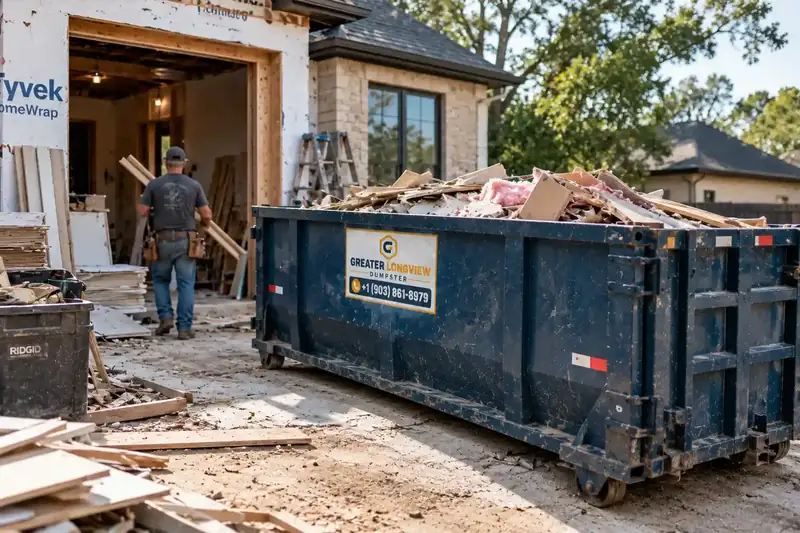
The only compliant, professional way to manage jobsite demolition is having a dedicated roll-off construction dumpster placed on your property the day before demolition begins.
Selecting the Right Container Size for Your Renovation Scope
Choosing the wrong size dumpster wastes money. Order too small, and you pay double delivery fees for a swap-out; order too large, and you pay for unused airspace. Here is our fleet sizing formula for East Texas homes:
| Dumpster Size | Bed Capacity | Weight Allowance | Ideal Renovation Scope |
|---|---|---|---|
| 10-Yard Roll-Off | ~4 Pickup Trucks | 1 – 2 Tons | Powder room gut, half-bath remodel, patio concrete teardown, or single small room drywall strip. |
| 15-Yard Roll-Off | ~6 Pickup Trucks | 2 – 2.5 Tons | Full master bathroom overhaul, carpet/flooring tear-out across 1,500 sq ft, or kitchen cabinet/countertop demo. |
| 20-Yard Roll-Off | ~8 Pickup Trucks | 3 – 3.5 Tons | The East Texas Remodeling Standard: Multi-room renovations, kitchen + bath combos, whole-home flooring, and deck demo. |
| 30-Yard Roll-Off | ~12 Pickup Trucks | 4 – 4.5 Tons | Whole-home structural gutting, major home additions, estate liquidations, or massive framing teardowns. |
Protecting Your Driveway Concrete from Heavy Roll-Off Wheels
During a Texas summer, residential concrete and asphalt driveways soften under 100°F sun. A roll-off container holding 3 to 4 tons of demolition debris can scar unshielded concrete. At Greater Longview Dumpster, every residential dispatch includes our 100% Driveway Protection Guarantee: heavy 2x10 wooden distribution boards placed beneath the steel rollers to disperse weight evenly and protect your driveway from cracking, scrapes, or tire scarring.
Phase 7: Demolition Day Protocol & Safe Debris Sorting
Demolition is the most cathartic phase of any remodel, but it also carries the highest risk of catastrophic mistakes (e.g., puncturing a live pressurized water line or cutting an active 240V feed).
Pre-Demo Utility Lockdown Checklist:
- Water Isolation: Locate the municipal curb stop box near the street and verify your main shutoff valve turns completely off. Drain remaining line pressure by opening the lowest exterior hose bib.
- Electrical Isolation: Turn off and lock out circuit breakers supplying the demo rooms. Use an audible non-contact voltage tester on every outlet and switch plate before reciprocating saws or prybars touch the wall.
- HVAC Protection: Cover return air grilles with filter fabric and tape down plastic sheeting (polyethylene film) across doorways with zip-up access doors. This keeps toxic drywall gypsum dust out of your ductwork and evaporator coils.
Separating Landfill Banned Materials: When filling your roll-off container, be mindful of Texas landfill regulations (TCEQ Region 5 rules for Pine Hill Landfill). Wet paint cans, liquid chemicals, car batteries, fluorescent ballast lamps, and freon-containing refrigerators cannot enter the container. (Review our comprehensive guide: What Can & Cannot Go In a Dumpster?).
Phase 8: Rough-In, Inspection Cycles, Finishes & Final Punch List
Once demolition debris is hauled off and the framing is exposed, your project enters the sequential build-back phase. Adhering to strict chronological order prevents trade conflicts and expensive rework:
- Structural Framing & Subfloor: Sistering damaged joists, leveling floors, and erecting new partition walls.
- Mechanical, Electrical & Plumbing (MEP) Rough-In: Plumbers set PEX lines and waste-vent stacks; electricians pull Romex wiring; HVAC contractors run ductwork branches.
- City of Longview Rough Inspections: All trades must be inspected simultaneously before closing up walls. The building inspector will check nail plate protection on studs, GFCI/AFCI wire routing, pipe pressure tests, and fire-blocking foam seals.
- Insulation & Soundproofing: Installing R-13 or R-15 batt insulation in exterior walls and rockwool in bathroom/laundry partitions for sound dampening.
- Drywall, Taping & Texture: Hanging sheetrock, applying joint compound across three coats, and spraying orange-peel or knockdown texture.
- Trim, Priming & Paint: Setting baseboards, casing, hanging interior doors, and applying high-durability eggshell or satin interior paint.
- Cabinetry & Hard Finishes: Setting kitchen and vanity cabinets, templating stone countertops, and tiling shower surrounds.
- Final Trim & Fixture Setting: Setting toilets, plumbing trim, pendant lighting, switch plates, and HVAC vent covers.
- Final City Inspection & Punch List: The municipal inspector verifies smoke/CO detectors, GFCI operations, and water heater temperature-pressure valves. Compile a final punch list with blue painter's tape for touch-ups before releasing the final contractor payment.
Frequently Asked Questions: East Texas Home Renovations
Common questions Longview homeowners and remodelers ask our dispatch desk when organizing their renovation waste and jobsite logistics.
Do I need a building permit for a home renovation in Longview, TX?
Yes, for any project involving structural alterations, wall removals, electrical rewiring, plumbing reconfiguration, HVAC replacement, or water heater installation, the City of Longview Development Services Department requires permits under the 2021 International Residential Code (IRC). Cosmetic updates like paint, wallpaper, and simple flooring replacements generally do not require a permit.
How much contingency budget should I save for an East Texas home remodel?
You should allocate a 15% to 20% financial contingency reserve above your estimated project costs. East Texas homes — particularly established mid-century ranches in neighborhoods like Spring Hill, Pine Tree, and Downtown Longview — frequently uncover hidden plumbing corrosion, knob-and-tube or aluminum wiring, termite damage, or foundation settlement once walls are opened.
What size dumpster do I need for a whole-home or multi-room renovation?
A 20-yard roll-off dumpster is the most popular choice for multi-room remodels, major kitchen overhauls, or flooring tear-outs across 1,500–2,500 square feet. For whole-home gut renovations, structural wall removals, or additions, a 30-yard dumpster (or multiple scheduled 20-yard swap-outs) is recommended to prevent site overflow.
Can I put home renovation and construction debris in City of Longview curbside pickup?
No. The City of Longview Sanitation Department strictly limits curbside bulky waste pickup to 8 cubic yards of household items and brush, and expressly prohibits contractor remodeling debris, sheetrock, roofing shingles, ceramic tile, concrete, and framing lumber. Placing construction waste at the curb can result in municipal code enforcement citations and fines.
How does East Texas red clay soil affect home renovation planning?
Gregg and Harrison counties have highly expansive red clay soil that swells during wet East Texas winters and shrinks significantly during hot, dry summers. Before removing interior walls or adding heavy stone countertops and tile spans, have a structural engineer or licensed contractor check your slab or pier-and-beam foundation to ensure prior settlement will not crack new finishes.