On any commercial job site across Longview, Tyler, or Kilgore, project schedules live and die by operational efficiency. Whether you are managing a ground-up retail development along Loop 281, an office tenant improvement off Hwy 80, or a multi-family framing project in Gregg County, unmanaged job site waste is one of the quickest ways to trigger OSHA safety citations, delay trade handoffs, and hemorrhage labor hours.
Effective construction waste management in Longview is not simply about having a steel dumpster dropped in the parking lot. It requires calculated job site staging, seamless container swap-out schedules, material segregation to avoid overweight penalties, and total compliance with City of Longview right-of-way and Texas Commission on Environmental Quality (TCEQ) regulations.
In this guide, Greater Longview Dumpster’s commercial operations team details the exact logistics frameworks our commercial general contractors use to maintain spotless job sites, eliminate trade downtime, and control disposal costs across East Texas.
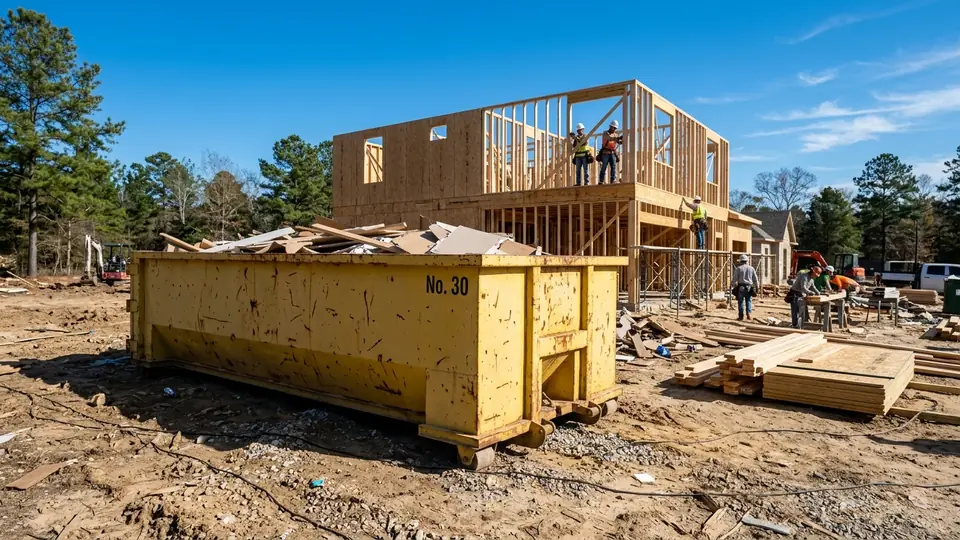
1. The Real Cost of Job Site Disorganization & OSHA Compliance
When debris piles accumulate on a commercial slab or around exterior framing perimeters, the consequences ripple across every subcontracted trade:
- OSHA Housekeeping Citations (29 CFR 1926.25): Federal safety standards mandate that all form and scrap lumber with protruding nails, sharp metal banding, and combustible debris must be cleared from work areas, passageways, and stairs at regular intervals. Failing an inspection leads to costly stop-work orders and repeat fines.
- Compounded Subcontractor Labor Loss: If drywallers, electricians, or mechanical crews have to spend the first 45 minutes of each morning clearing framing off-cuts and trash out of rooms before staging their tools, the general contractor is paying premium trade rates for basic janitorial work.
- Puncture & Slip Injuries: Scrap lumber, exposed screws, and plastic wrap represent the single greatest cause of minor job site injuries and workers' comp claims during the rough-in and framing phases.
- Stormwater Contamination (SWPPP): The City of Longview and Gregg County enforce strict Stormwater Pollution Prevention Plans. Loose construction sediment, drywall dust, and packaging blown into municipal gutters can result in environmental stop-work citations.
2. Job Site Staging: Placement, Ingress & Turning Radii
Where you position your commercial roll-off containers determines how efficiently trades use them and how easily our heavy haulers can service your site. A standard tri-axle roll-off truck delivering a loaded 30-yard or 40-yard container weighs upwards of 54,000 lbs and requires specific physical clearances:
| Job Site Factor | Logistical Requirement | East Texas Field Consideration |
|---|---|---|
| Straight Approach Lane | Minimum 50 to 60 feet of straight clearance | Keep clear of parked subcontractor pickup trucks during morning deliveries. |
| Vertical Overhead Clearance | Minimum 22 to 25 feet clear | Watch for commercial power drops, high-voltage lines, and site lighting poles. |
| Ground Surface Bearing | Compacted caliche, crushed base, or heavy asphalt | East Texas red clay softens quickly during rainstorms; avoid uncompacted soil. |
| Distance from Workface | Within 40 to 75 feet of primary egress | Position close enough for wheelbarrow access without blocking telehandlers. |
Pro Tip on Concrete Protection: When placing roll-off boxes on freshly poured commercial concrete approaches or finished asphalt parking lots in Longview, inform our dispatch desk. We deploy commercial-grade wooden dunnage timbers beneath the container guide rollers to eliminate surface scraping and point-load fractures.
3. Phased Container Selection: Matching Sizes to Construction Milestones
Commercial builds evolve through distinct phases, each generating drastically different waste profiles. Smart contractors match container capacities to the active scope:
Phase 1: Civil, Groundwork & Concrete Demo
During foundation preparation, footing excavation, or demolition of old curb and asphalt, waste consists of high-density inert material. Here, large 30-yard or 40-yard dumpsters are strictly forbidden due to legal highway weight limits. A 30-yard container filled with broken concrete would weigh over 35 tons—far exceeding the legal 10-ton road limit.
Recommended Container: Dedicated low-sided 10-yard or 12-yard heavy material dumpsters. The low 3.5 to 4-foot sidewalls allow skid steers and mini-excavators to dump directly over the rim.
Phase 2: Framing, Sheathing & Structural Rough-In
Wood framing, plywood cutoffs, engineered joist scraps, metal studs, and moisture barrier wrap produce massive physical volume with relatively low overall weight.
Recommended Container: Standard 30-yard roll-off dumpster or high-capacity 40-yard roll-off dumpster. The 6-foot to 8-foot sidewalls keep bulky dimensional lumber securely contained even in gusty East Texas weather.
Phase 3: MEP Rough-In, Drywall & Interior Finishes
Drywall sheet scrap is heavy (approx. 50 lbs per 1/2-inch 4x8 sheet) and dense. Combine that with cardboard ductwork packaging, conduit cutoffs, plumbing pipe, and palleted packaging.
Recommended Container: 20-yard roll-off dumpster for dense drywall phases, or 30-yard containers paired with disciplined loading.
4. Live-Load & Swap-Out Scheduling: Preventing Job Site Bottlenecks
There is nothing more frustrating for a superintendent than watching a demo crew stand idle because the on-site container is overflowing. To maintain an uninterrupted workflow, commercial contractors rely on our scheduled swap-out logistics:
- Same-Day Swap Protocol: When your site foreman calls or texts our Pine Tree Rd dispatch office before 11:00 AM, our driver hauls a replacement empty container to your site, retrieves the full container, and spots the empty in the exact same footprint in one seamless 15-minute maneuver.
- Recurring Standing Swaps: For major commercial builds with predictable waste flows, we establish standing pickup days (e.g., every Tuesday and Friday morning). Your site maintains continuous capacity without foremen having to remember to call dispatch.
- Live-Load Hauling: For congested downtown Longview sites or urban street fronts where municipal right-of-way permits prohibit leaving an unattended container overnight, our truck arrives, stays on-site for 60 to 90 minutes while your crew loads with bobcats, and departs immediately.
5. Gregg County Regulations, Landfill Rules & LEED Reporting
Commercial construction disposal in East Texas is subject to local, county, and state environmental mandates:
- Tarping & Spillage Mandates: All commercial waste hauled through Longview city limits along Loop 281, Hwy 80, and I-20 must be mechanically tarped and sealed. Waste cannot protrude above the top rim of the container.
- Prohibited Materials Enforcement: Wet paint, chemical solvents, untagged freon compressors, asbestos-containing siding, and lead-acid batteries are rejected at the Pine Hill Landfill scales. Review our Prohibited Waste Guide to keep hazardous materials off your commercial ticket.
- Weighbridge Manifest Documentation: Commercial accounts receive detailed weight scale manifests for every ticket pulled, providing certified gross, tare, and net weights for job cost accounting.
6. Frequently Asked Questions: Commercial Waste Logistics
How quickly can Greater Longview Dumpster perform a container swap-out on an active job site?
For commercial contractors enrolled in our dedicated builder program, we offer same-day and guaranteed next-morning swap-outs. When you notify our Pine Tree Rd dispatch desk by 11:00 AM, our driver hauls the full container and drops a fresh empty roll-off simultaneously so your framing or demo crews experience zero downtime.
What size roll-off dumpsters are best for commercial construction projects in East Texas?
Commercial builds typically require 30-yard or 40-yard roll-off containers for high-volume framing scrap, drywall cutoffs, packaging, and interior strip-outs. However, for masonry, dirt excavation, and slab tear-outs, we stage dedicated low-profile 10-yard or 12-yard containers to comply with highway weight regulations.
What are OSHA requirements for construction site waste disposal?
Under OSHA standard 29 CFR 1926.25 (Housekeeping), all form and scrap lumber with protruding nails, along with general combustible debris, must be cleared from work areas, passageways, and stairs around buildings. Staging accessible roll-off dumpsters prevents citations and eliminates slip, trip, and puncture injuries.
Do you provide LEED diversion reporting and waste manifests for commercial jobs in Gregg County?
Yes. Upon request, we provide certified weighbridge scale tickets and waste diversion tracking for commercial builders in Longview, Tyler, Kilgore, and Marshall aiming for LEED certification or corporate sustainability reporting.