When homeowners in Longview, Spring Hill, and Pine Tree start a deck demolition project, the sheer volume of disassembled lumber catches them by surprise. A deck that measures 16x20 feet (320 square feet) looks relatively compact while assembled, but once you pry up the 5/4x6 decking planks, knock down the railings, and cut away the 2x8 joists, that wood fluffs up significantly.
Unlike heavy soil or gravel, demolition lumber creates substantial "dead airspace" inside a container. Nails, angled joist hangers, and warped railings prevent planks from sitting perfectly flat. Below, we break down exact volume formulas, dumpster size recommendations, weight allowances, and contractor packing strategies so you get your yard cleared safely without paying for multiple container trips.
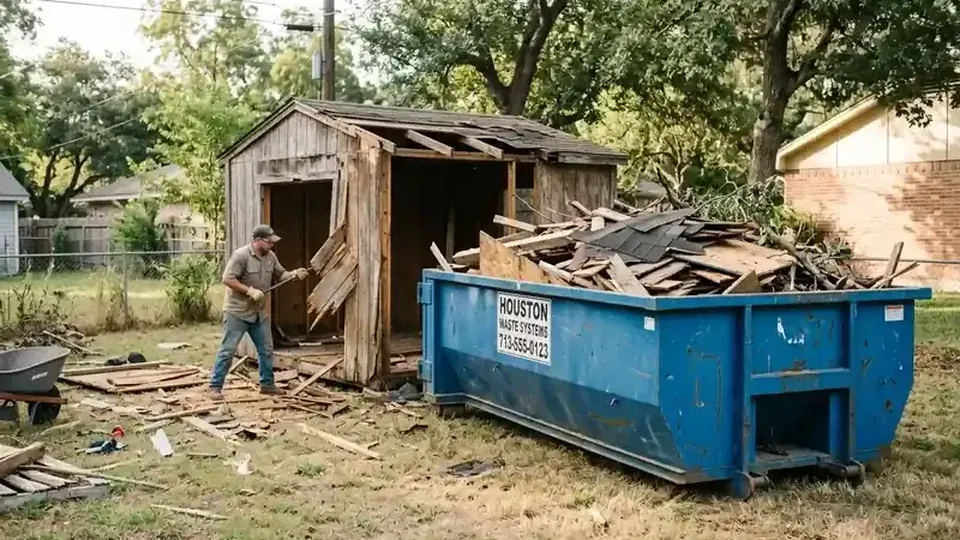
At Greater Longview Dumpster, dispatching daily from 115 Pine Tree Rd, we deliver residential roll-offs with our 100% Driveway Protection Guarantee. We place heavy timber runner boards beneath the steel rollers to safeguard your concrete or asphalt driveway against scratches, cracking, or surface damage.
1. How to Calculate Cubic Yards from Deck Square Footage
A common homeowner mistake is measuring only the surface floor area of the deck and forgetting the massive subframe below it. A complete residential deck tear-down consists of multiple distinct material layers:
- Surface Decking Boards: Typically 5/4" x 6" pressure-treated southern yellow pine or composite boards (Trex, TimberTech).
- Perimeter Railings & Balusters: Top rails, bottom rails, spindles spaced every 4 inches, and 4x4 support posts.
- Underlying Framework: 2x8 or 2x10 joists spaced 16 inches on center, plus 2x10 double perimeter rim joists and beams.
- Vertical Support Posts: 4x4 or 6x6 treated pine posts running into the ground or bolted to concrete deck piers.
- Stair Strings & Steps: 2x12 cut stair stringers and double treads which take up tremendous irregular space.
Every 20 to 25 square feet of standard single-level deck framing creates approximately 1 cubic yard of loose demolition debris. For elevated second-story decks or decks with elaborate pergolas and multi-tier staircases, figure 15 to 18 square feet per cubic yard.
2. Deck Demolition Dumpster Sizing Matrix
Match your deck's dimensions and square footage to our roll-off container fleet below:
| Deck Dimensions | Square Footage | Estimated Loose Volume | Recommended Container | Included Weight Allowance |
|---|---|---|---|---|
| 10' x 12' (Small patio landing) | 120 sq ft | 5 – 6 cubic yards | 10 Yard Dumpster | 2.0 Tons (4,000 lbs) |
| 12' x 16' (Standard suburban porch) | 192 sq ft | 8 – 10 cubic yards | 12 Yard Dumpster | 2.5 Tons (5,000 lbs) |
| 14' x 20' (Medium family deck) | 280 sq ft | 12 – 14 cubic yards | 15 Yard Dumpster | 3.0 Tons (6,000 lbs) |
| 16' x 24' (Large backyard deck) | 384 sq ft | 16 – 18 cubic yards | 20 Yard Dumpster | 3.0 Tons (6,000 lbs) |
| 20' x 30'+ (Multi-tier with pergola) | 600+ sq ft | 24 – 30 cubic yards | 30 Yard Dumpster | 4.0 Tons (8,000 lbs) |
3. How to Load Your Dumpster to Maximize Space & Save Money
Because demolition lumber is long and rigid, loading technique makes a huge difference. If you toss 16-foot 2x10 joists diagonally into an 8-foot-wide container, they will create empty caverns beneath them, causing the dumpster to overflow before you are halfway through the job.
Under Texas Department of Transportation (TxDOT) regulations, roll-off containers cannot be transported on public roads if debris extends above the top steel sidewalls or prevents the tarp from latching flat. Cutting long joists in half guarantees compliant transit.
A. Cut 12-to-16 Foot Joists in Half
Run a circular saw or reciprocating saw down the center of your framing boards. Cutting lumber into 6-to-8 foot lengths allows boards to lay flat across the full floor width of the roll-off, eliminating wasted void space.
B. Use the Rear Walk-In Gate
All Greater Longview Dumpster roll-offs feature ground-level rear swing-open gates. Open the rear door and carry heavy 4x4 or 6x6 support posts, beams, and railings directly into the front bulkhead first, stacking them uniformly like cordwood.
C. How to Handle Concrete Deck Piers
If you dig up pre-cast concrete deck blocks or poured concrete footings attached to post bases, place them flat on the container floor. Concrete is dense (approx. 145 lbs/cu ft); distributing piers across the bottom ensures proper axle weight balance.
4. Can You Put Pressure-Treated Wood in a Dumpster in Longview?
Yes! Pressure-treated lumber (copper azole, ACQ, or older CCA-treated wood) is standard construction and demolition debris accepted in our containers. Because Texas environmental laws strictly prohibit burning pressure-treated wood (burning releases toxic arsenic and chemical fumes into the air), a roll-off dumpster is the cleanest, EPA-compliant disposal channel.
Review our Residential Dumpster Rental in Longview page or explore Construction Roll-Off Services for contractor jobsite pickups.
Frequently Asked Questions: Deck Demolition Dumpster Rentals
Will a 10-yard dumpster hold a 200 sq ft deck?
Yes, as long as you cut the joists into 6-to-8-foot lengths and stack the surface planks flat. If the deck has heavy railings, elevated stairs, or high posts, a 15-yard dumpster provides better breathing room.
Can I throw concrete deck footings into the dumpster?
Yes. Small concrete piers are permitted. However, concrete is very heavy (approx. 145 lbs per cubic foot). Distribute footings evenly on the floor so the load does not exceed your tonnage allowance.
How does driveway protection work during drop-off?
Greater Longview Dumpster provides a 100% Driveway Protection Guarantee. Our drivers place heavy wooden protection boards beneath the steel rollers to safeguard your concrete or asphalt driveway from scratches or cracking.